
Introduction: From AI Hype to AI Oversight
At Microsoft Ignite 2025, the conversation around AI shifted from excitement over capabilities to serious discussions about control and trust. In an era where AI is a board-level concern, business leaders are asking not “How do we adopt AI?” but “How do we safely control and govern AI at scale?”. Microsoft’s answer to this challenge is Microsoft Agent 365, unveiled at Ignite 2025 as a centerpiece of its new governance-focused strategy. Agent 365 is described as “the control plane for AI agents”, a unified system to deploy, monitor, and manage AI agents with confidence. Its release reflects Microsoft’s pivot from pure AI hype to prioritising governance, compliance, and accountability, aligning with what CIOs and CISOs now demand. In fact, IDC projects there will be 1.3 billion AI agents by 2028, and enterprises face a pressing question: how to responsibly govern this explosion of AI workers at scale without overhauling their trusted systems. Agent 365 addresses this by building on familiar enterprise tools to bring oversight to AI. In Microsoft’s view, the clearest path forward is to “manage agents the way you manage people,” using the same infrastructure and protections your business already trusts.
Disclaimer: Features described are based on Ignite 2025 announcements and may evolve.
Notably, Agent 365 is initially available through Microsoft’s Frontier early-access program, meaning many capabilities are in preview and subject to change as the product matures.
What is Microsoft Agent 365?
Microsoft Agent 365 is a new cloud-based service (integrated into the Microsoft 365 Admin Center) that acts as a central control hub for AI agents across the enterprise. In Microsoft’s words, Agent 365 “helps you deploy, organise, and govern [AI agents] securely”, whether they’re built on Microsoft’s platforms or third-party frameworks. In practice, this means business and IT leaders get a single place to see what AI agents are in use, what they’re doing, and what risks or value they bring. Agent 365 doesn’t replace your existing Microsoft 365 or security tools. Instead, it ties into them, extending Microsoft’s Copilot and AI ecosystem with a governance layer. It’s the next evolution of enterprise IT management: just as organisations manage user accounts, devices, and applications, they can now manage AI agents as first-class entities in their environment.
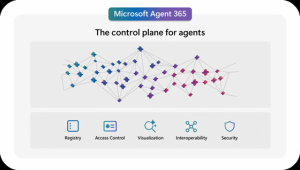
Figure: Microsoft Agent 365 is the “control plane” for AI agents, providing five core pillars for enterprise-scale AI management—Registry, Access Control, Visualisation, Interoperability, and Security.
At Ignite, Microsoft positioned Agent 365 as fundamental to its AI and Copilot vision. It complements the Microsoft 365 Copilot experience by adding robust oversight for the new wave of AI-driven assistants (“agents”) being introduced. For example, Agent 365 works hand-in-hand with Work IQ (Microsoft’s organisational intelligence layer) to ensure any custom AI agent or Copilot has the right grounding in your company’s data and respects all your permissions, compliance rules, and policies. In short, Agent 365 is the administrative brain that keeps AI agents in check. It inventories all AI agents running in your tenant, no matter how they were created, and lets you govern them centrally. Microsoft stresses that this spans agents built with Microsoft’s own tools (like Copilot Studio or the new Foundry platform) as well as third-party and open-source agents. This openness is key, Agent 365 isn’t limited to Microsoft-only bots; it’s designed to oversee a heterogeneous “fleet” of AI across the organisation. The more the 3rd party agents are prepared to expose, the better the oversight will be.
Unified Observability and Proactive Monitoring
One of Agent 365’s most important roles is to provide unified observability over all AI agent activities. For many organizations, a big concern is “AI sprawl”, different teams experimenting with various AI bots without central visibility or control. Agent 365 tackles this head-on by giving IT a single dashboard with telemetry, analytics, and alerts for every agent in use. This means no more blind spots. IT admins and security teams can track every agent being used, built, or brought into the organisation, eliminating blind spots and reducing risk.
Crucially, Agent 365 moves beyond basic monitoring to AI-driven oversight that is actionable. Oversight is most effective when it yields insights, and Agent 365’s Visualisation features do exactly that. The system maps out how agents interact with users, data, and each other, giving a full picture of your “agent mesh” across the company. Through a unified dashboard, you can see connections among agents and systems, usage trends, and even performance metrics. For instance, leaders get role-based reports that highlight the metrics that matter to them, IT can see system performance and adoption, security teams see risk indicators, and business owners see the impact and ROI of agents on their processes. Instead of hunting through logs, stakeholders have relevant information delivered in their flow of work.
In practice, Agent 365’s Agent Overview console surfaces key metrics like the total number of agents deployed, active users, and even estimated hours saved by AI automation, making the business impact immediately clear. It also proactively flags situations that may need attention. For example, the dashboard will highlight “Top Actions” for admins, such as if there are any flagged risky agents, pending access requests, ownerless (orphaned) agents, or policy exceptions that require intervention. This proactive monitoring helps IT leaders focus on what matters most. Rather than reacting after an issue occurs, Agent 365 uses AI-driven analysis to spot anomalies or risks in near real time, essentially an early warning system for your AI estate. An admin can quickly see, for example, that a particular sales bot has an unusually high error rate or that an unauthorised “shadow” agent is trying to access corporate data, and then take immediate action.
To make oversight even more effective, Agent 365 includes built-in analytics for agent performance. Managers can track each agent’s speed and quality of outputs to assess its return on investment (ROI) and decide whether to scale it up or make improvements. This ties AI monitoring to business value, you can directly measure if an agent is actually improving productivity or just churning out noise. End-users who supervise or work alongside an AI agent also gain visibility into how well that agent is adhering to assigned tasks and the outcomes it’s generating. Such transparency builds trust: employees and leaders can clearly see what the AI is doing and how it’s contributing.
Security, Compliance and Responsible AI Governance
For organisations concerned about AI risk management, Microsoft Agent 365 introduces governance controls to ensure AI agents operate within safe boundaries. Security and compliance are not afterthoughts here, they are designed into Agent 365 from the ground up. Every agent in the system is assigned a unique Entra Agent ID (through Microsoft Entra, Azure AD’s evolution), which means agents are treated like identities that can be governed. This identity-centric approach allows IT to apply role-based access control and the principle of least privilege to AI agents, just as you would for human users. In other words, each agent gets only the minimum permissions it needs and nothing more, which dramatically reduces the risk of an AI agent unintentionally or maliciously accessing sensitive information. Administrators can set guardrails on who is allowed to create or deploy new agents, ensuring there’s an approval workflow and oversight on the “birth” of any AI in the organisation.
Agent 365’s Registry function acts as a single source of truth for all agents in the enterprise. If an AI agent isn’t registered and approved, Agent 365 will see it as a “shadow agent.” Security teams can then quarantine unsanctioned agents, preventing any rogue or unknown bot from interfacing with users or connecting to company systems. This is akin to an “IT blacklist” for unauthorised AI, closing a gaping hole in AI governance (previously, a clever employee could spin up an agent on the side without anyone knowing; now such shadow agents are detectable and blockable). The registry, backed by Microsoft Entra, is rich with metadata on each agent, showing its owner, usage stats, what platform it was built on, last update, and more. This makes auditing and lifecycle management much easier, as you can quickly filter and find agents by department, by risk level, by vendor, etc., and take actions like blocking or updating an agent directly from the registry interface.
On the compliance front, Agent 365 is deeply integrated with Microsoft Purview, Microsoft’s suite of compliance and data governance tools. Every interaction that an agent has (e.g. prompts, actions it takes, content it generates) can be captured in audit logs for review. Microsoft has ensured that “prompts and responses are captured in the unified audit log” of Purview, meaning you have a record of what your AI is being asked and what it’s outputting, a critical requirement for accountability. Agent 365 thus supports transparent and traceable AI: you can hold agents (and their human operators) accountable because there’s an audit trail. Compliance managers can use familiar Purview tools like eDiscovery and Communication Compliance to detect if an agent’s output violates company policy or regulations. In fact, Agent 365 can automatically flag and even halt “unethical or inappropriate” agent interactions by leveraging Purview’s policies. This could include, for example, an agent producing content that breaches a code of conduct or tries to share sensitive data it shouldn’t. By catching such events, Agent 365 helps organisations stay “audit-ready” even as they deploy AI at scale.
From a security standpoint, Agent 365 brings Microsoft’s formidable security stack to bear on AI. It integrates with Microsoft Defender and the broader Microsoft Security suite to provide threat detection and protection specifically tailored to AI agents. Security teams can see a unified security posture for all agents, including any vulnerabilities or misconfigurations in those agents, and receive alerts just as they would for other cybersecurity issues. Notably, Microsoft has built AI-driven protections here: Agent 365 uses AI-powered threat intelligence to identify and block novel attacks on AI agents in near real time. For example, one emerging risk is prompt injection attacks, attempts to feed malicious instructions to an AI agent to manipulate its behaviour. Microsoft specifically calls out that Agent 365’s security layer can guard against “AI cyberattacks such as prompt injections”. If an agent starts behaving suspiciously (say, an unknown process tries to use an agent to exfiltrate data), Agent 365 working with Defender and Entra can automatically cut off that agent’s access in real-time response. This autonomous enforcement is crucial when threats move at machine speed.
Microsoft Purview’s involvement also means data loss prevention (DLP) is extended to AI. Agent 365 ensures that agents cannot process or leak sensitive data in violation of your policies. For instance, if an AI agent tries to read content classified as “Highly Confidential,” Purview can intervene, or if an agent’s output contains what looks like personally identifiable information, it can be redacted or blocked. Purview monitors for risky behaviours (like an agent that suddenly accesses an unusually large amount of data or attempts transactions outside its normal pattern) and can apply adaptive policies if something looks off. All these controls help maintain compliance with evolving AI regulations: Agent 365 will even recommend controls or safeguards to meet new regulatory requirements as they emerge. This kind of built-in compliance guidance means that as laws around AI (privacy, accountability, etc.) continue to evolve, Agent 365 can assist organisations in keeping up.
In summary, Agent 365 imbues the use of AI with the same rigor and Responsible AI practices that enterprises expect in other areas of IT. It enforces accountability (through audit logs and unique IDs), transparency (clear insights into what agents are doing), fair use and ethics (policies to catch inappropriate content), and security & privacy (preventing data leaks and external threats). Microsoft’s own Responsible AI principles, fairness, reliability & safety, privacy & security, inclusiveness, transparency, and accountability are reflected in Agent 365’s design. The tool is essentially an implementation of “AI governance by design”: making sure that every AI agent in the business is controlled, observable, and compliant by default.
Part of Microsoft’s Broader AI and Copilot Ecosystem
It’s important to understand that Agent 365 is not a standalone point solution; it fits into Microsoft’s broader AI and Copilot ecosystem as a foundational layer. Microsoft has been rapidly expanding its AI offerings, from Microsoft 365 Copilot (the AI assistant embedded in Office apps) to a plethora of specialised “Copilot” agents for security, development, sales, etc. The introduction of Agent 365 signals that all these AI capabilities will be governed under a common framework. In fact, Microsoft is positioning tools like Agent 365, Entra Agent ID, and Foundry Control Plane as “core pillars” of its enterprise AI strategy. They recognise that for organisations to fully embrace AI, they need confidence in oversight; thus governance tooling is just as critical as the AI features themselves.
Integration with existing Microsoft platforms is a big selling point for Agent 365. Users access Agent 365 through the familiar Microsoft 365 Admin Center, and it plugs into the tools admins already use. As Microsoft’s documentation notes, “Agent 365 integrates identity, compliance, and security from Microsoft Entra, Microsoft Purview, and Microsoft Defender,” presenting a unified experience with dashboards and alerts. A security professional can thus find Agent 365 controls right alongside their other security dashboards. For example, in Entra (Azure AD) you’ll manage agent identities and access policies; in Purview, you’ll review agent audit logs and compliance status; in Defender, you’ll investigate agent-related threat alerts. All of this is coordinated so that IT and security teams have a single control plane for users, applications, and AI agents, instead of siloed systems. This tight integration reduces the learning curve and ensures that adopting Agent 365 doesn’t mean yet another console to monitor, but rather an extension of the Microsoft security and compliance environment you already have.
Agent 365 also fits naturally with Copilot development tools. Microsoft has introduced Copilot Studio and Microsoft Foundry as platforms to create custom AI agents and copilots. Agent 365 serves as the governance layer over those creations. Developers can build or fine-tune an AI agent in Copilot Studio or Foundry, and then publish it directly into Agent 365 for enterprise enablement. This handoff means the moment an agent moves from experiment to production, it’s automatically subject to the full governance regime of Agent 365 (security scans, registration, compliance checks, etc.). It encourages a DevOps-like model for AI: build fast, but build governed. Microsoft even provides an Agent 365 SDK and support for open frameworks, indicating that whether an organisation’s AI projects are pro-code, low-code, or vendor-provided, they can all live under Agent 365’s oversight.
This ecosystem approach is critical for business strategy because it prevents fragmentation. Companies can innovate with AI through various Microsoft Copilots (be it a Sales agent in Dynamics 365, a summarisation bot in Teams, or a custom process automation agent built in-house) and know that Agent 365 is uniformly watching over all of them. By fitting into Microsoft’s wider “Frontier” vision (a term Microsoft uses for firms that are human-led and AI-powered), Agent 365 helps ensure that as organisations push into new AI use cases, they maintain a strong “trust layer.” Microsoft even launched a Frontier early-access program in which customers can test tools like Agent 365 in preview showing that they’re co-developing these governance capabilities with feedback from real enterprises concerned about AI risks.
Business Value and Strategic Implications for AI Risk Management
For business and technology leaders, the introduction of Microsoft Agent 365 is a clear sign of the times: AI adoption must go hand-in-hand with risk management and governance. Early on, many enterprises enthusiastically jumped on generative AI and Copilots to boost productivity. Now, as those AI systems proliferate, leaders are rightly concerned about oversight, compliance auditors, regulators, and boards are asking tough questions about how AI is being controlled. Agent 365 squarely addresses these concerns by providing the mechanisms to monitor, audit, and govern AI at scale, which in turn enables organisations to embrace AI more confidently.
Perhaps the biggest business benefit of Agent 365 is that it allows innovation with reduced fear of the unknown. It’s telling that industry observers have noted “‘AI-powered’ is passé; ‘AI-accountable’ is now the growth engine.” Modern enterprises aren’t just looking for flashy AI features, they want assurances that AI can “prove compliance, reduce exposure, and automate safely.” By embedding compliance and accountability features, Agent 365 essentially turns AI agents into manageable corporate assets rather than wild experiments. This gives executives and risk committees peace of mind. A CEO or board can green-light an AI pilot program knowing there’s a governance framework to keep it within guardrails and evidence to demonstrate due diligence.
Agent 365 also brings strategic clarity by aligning AI initiatives with existing governance frameworks. Many companies have well-established IT governance, cybersecurity, and data compliance processes; the worry with AI was that it introduced a parallel universe of risk that wasn’t covered by those processes. Microsoft’s strategy, “governance is ultimately more important than innovation theatre” resonates here. With Agent 365, AI oversight is woven into the same fabric as everything else (identity management, data governance, etc.), which means enterprises can incorporate AI into their risk assessments and controls in a familiar way. This unified governance fabric is precisely what many tech buyers have been waiting for. It turns AI from a potential rogue element into another area of operational excellence.
For business leaders, an immediate implication is improved accountability and transparency in AI operations. Agent 365 makes it possible to answer key questions that a CIO or CISO might get from the board or regulators: How many AI systems are we running? What data can they access? Who is responsible for them? Are they compliant with our policies and industry regulations? With Agent 365, these answers are at their fingertips, every agent is inventoried, owners are assigned (and workflows are in place to reassign or decommission agents if an employee leaves), and logs can be pulled to demonstrate what the AI has been doing. Such capabilities will be invaluable in audits or even just internal reviews. They demonstrate responsible AI practice, that the company isn’t just unleashing AI for productivity, but also controlling it, much like financial controls are in place for accounting processes.
Importantly, Agent 365 supports a proactive stance on AI risk rather than a reactive one. Instead of waiting for something to go wrong (a data leak by an AI, a regulatory fine, a public relations issue over an AI decision) and then scrambling, organisations can use Agent 365 to continuously enforce compliance and mitigate risks in near real time. For example, if a new regulation about AI transparency comes into effect, compliance teams can apply the required policy uniformly to all agents via Agent 365 and be confident it’s being followed. This agility in governance could become a competitive advantage. Businesses that manage AI well will be able to scale it faster and more widely, giving them an innovation edge without inviting undue risk. Conversely, those who adopt AI without proper controls might hit roadblocks or incidents that erode stakeholder trust.
Finally, the introduction of Agent 365 highlights a broader industry trend: AI solutions are maturing from experimental toys to enterprise-grade tools with governance at the core. Microsoft’s move to make governance “a foundation, not a feature” is a substantial step change in the market. It raises the bar for other AI vendors, enterprises will expect similar oversight capabilities from any AI platform they use. For Microsoft-focused businesses, Agent 365 and its companion tools (Entra Agent ID, Security Copilot integrations, expanded Purview controls) form a comprehensive toolkit for AI risk management. Adopting these tools is becoming part of the AI strategy. In sum, Agent 365 enables business leaders to pursue the benefits of AI (efficiency, productivity, new insights) while firmly anchoring those efforts in a framework of trust, compliance, and responsibility. It’s a crucial enabler for what Microsoft calls the “Frontier firm”, a company that is human-led and AI-empowered, but always in a controlled and governed manner.