The Space to Ask
How AI tutors can change the way we learn, and why the freedom to ask a question, more than the answer itself, may be the real breakthrough.

The most valuable thing an AI tutor may offer is not an answer, but the freedom to ask the question. Learning has always depended on curiosity, yet curiosity is not always expressed openly. In schools, universities and workplaces, people often leave questions unasked because they are unsure how to formulate them, believe they should already know the answer, or feel that the discussion has moved beyond them. The question remains, but the opportunity to resolve it disappears.
This does not mean that traditional learning environments have failed, nor does it diminish the role of teachers, lecturers, trainers or mentors. Human educators remain essential because they bring judgement, context, encouragement and perspective. They understand the wider purpose of the lesson, recognise the dynamics of a group and help learners connect knowledge to the world around them. Yet every shared learning environment has practical limits. Time is finite, attention is divided and people do not all learn at the same pace or through the same type of explanation.
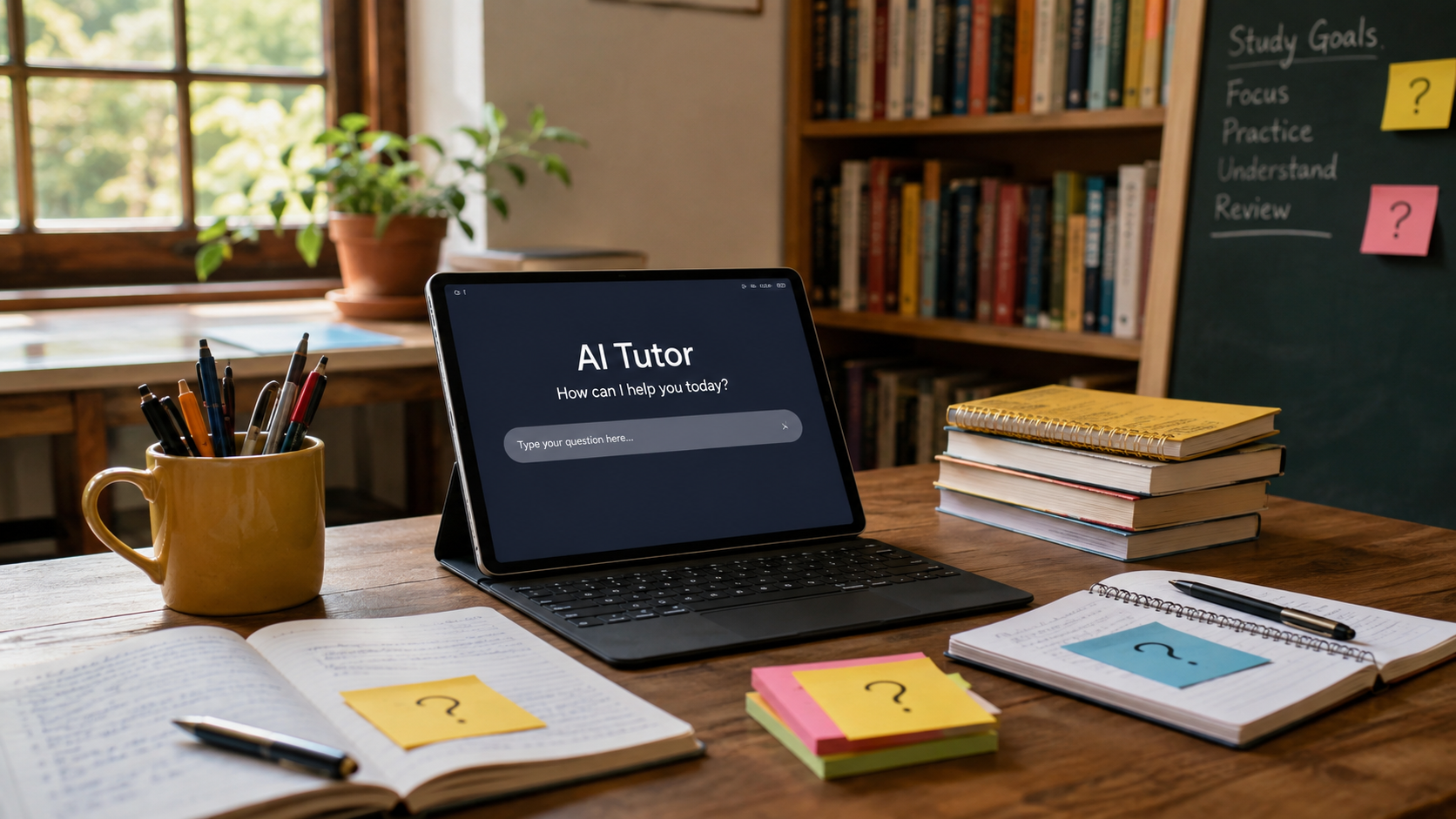
An AI tutor creates a complementary space in which the learner can pause, return, question and explore without affecting anyone else’s progress. That space is significant because it changes more than access to information. It changes the learner’s relationship with learning itself.
Learning in Our Own Way
People rarely struggle with a subject simply because they are incapable of understanding it. More often, the explanation has not yet connected with the way they think. One person may need a practical example, while another needs to understand the underlying principle. Someone else may need the language simplified, the sequence changed, or the concept compared with something already familiar.
In a group setting, it is difficult to accommodate every variation in real time. An AI tutor can continue the conversation individually, adapting its language, changing its approach and following the learner’s questions until the idea begins to make sense.
Two learners can be presented with the same material, by the same educator, and encounter entirely different points of difficulty.
This is more than personalisation in the technical sense. It is a recognition that understanding is not standardised. They may share the same curriculum, role or objective, but they will not necessarily arrive at comprehension by the same route. An AI tutor gives each learner the space to find that route for themselves.
The Importance of Asking Again
One of the most underestimated barriers to learning is the reluctance to ask a question twice. A learner may ask for clarification, receive a correct answer and still remain uncertain. The explanation may have been accurate, but not useful to that particular person. Asking again can feel awkward, especially when others appear to have understood. The learner may therefore move forward with only partial understanding, carrying a small gap that later becomes a larger one.
An AI tutor removes much of this friction. The learner can ask for a simpler explanation, a more technical explanation or a completely different way of approaching the subject. They can revisit a basic term, return to an earlier concept or explore a question that falls outside the immediate lesson. There is no penalty for repetition and no expectation that understanding must arrive on the first attempt.
This matters because deep learning is rarely immediate. It is usually built through iteration: questioning, testing, reconsidering and connecting new ideas to existing knowledge. The ability to ask again is therefore not a minor convenience. It is part of the process through which genuine understanding is formed.
Confidence Built on Understanding
Confidence grows from this process. It is often treated as something separate from competence, but the two are closely connected. People become more confident when they understand why something works, not merely what they are expected to do. They are more willing to contribute when they have had the opportunity to test their thinking, and they perform better when uncertainty has been explored before it becomes pressure.
An AI tutor can support this quietly and continuously. A student can use it to prepare before contributing in class. An employee can clarify a process before making a decision. A new manager can explore unfamiliar concepts before leading a discussion. A person entering a new field can build the vocabulary and understanding required to participate with confidence.
The technology does not create confidence through reassurance alone. It creates confidence by giving the learner repeated evidence that difficult ideas can be understood.
Better Questions, Better Performance
The effect extends beyond formal education. In the workplace, unanswered questions often become hidden weaknesses. People may follow a process without understanding it, avoid contributing to discussions or depend too heavily on others for decisions they could make themselves. When learners have a private space to explore uncertainty, they can prepare more thoroughly, understand context more deeply and enter human conversations with better questions.
This does not reduce collaboration. It improves its quality. Teachers can spend more time challenging ideas and guiding deeper discussion. Managers can focus on judgement rather than repeated explanation. Teams can devote more attention to solving problems instead of working around unspoken gaps in understanding. The learner becomes more independent, but also more capable of contributing to others.
A More Human Outcome
The debate about AI in education often begins with the technology: what it can generate, automate or scale. A more interesting place to begin is with the learner. What changes when a person always has somewhere to take a question? What changes when they can learn without pretending to understand? What changes when the explanation adapts to them, rather than requiring them to adapt to the explanation?
The answer may be more than improved knowledge. It may be the development of people who are more confident, more curious and better equipped to act on what they know. The real promise of the AI tutor is not that it makes learning less human, but that it gives more people the space to become more capable human beings.